
January 20, 2026
January 20, 2026
Custom vs Template Driving School Website: Costs and ROI
This article compares custom and template driving school websites by cost, risk, and return on investment. It explains which option delivers faster results, lower risk, and a clearer path to profitability.


The decision behind the website
When a driving school owner plans a new website, the real decision is not about design preference or visual style. It is a business decision that affects cost structure, speed to market, risk exposure, and how quickly the website starts generating student inquiries. Choosing between a custom-built website and a template-based solution defines how much uncertainty the business accepts before seeing any return.
Most driving school websites underperform not because they look outdated, but because the initial website choice delayed learning and locked resources into assumptions. To evaluate this decision correctly, it must be analyzed through cost, risk, and return on investment rather than creativity or uniqueness.
Cost structure
A custom driving school website usually involves layered costs that extend beyond the visible price tag. Design discovery, revisions, development iterations, and post-launch adjustments increase both direct expenses and opportunity cost. These investments are made before the site attracts traffic, ranks in search, or produces enrollments, which places immediate financial pressure on the business.
Template-based websites operate on a fixed and predictable cost model. The core structure, layout, and user flow already exist, allowing the driving school to focus spending on content, local SEO, and promotion instead of prolonged development. The financial difference is not marginal. Lower upfront cost reduces breakeven time and allows faster reinvestment into growth channels.
From a cost perspective, templates reduce downside without limiting the ability to scale.
Time to launch
Time is one of the most overlooked variables in website ROI. Custom websites often take weeks or months to launch due to planning cycles, feedback loops, and design changes. During this period, the website generates no SEO signals, no behavioral data, and no validation of assumptions. Every delay postpones learning and revenue.
A template-based driving school website can be launched quickly because the structure is already resolved. Pages, enrollment paths, and content hierarchy are in place, which allows the owner to move directly into refinement and optimization. Faster launch means earlier indexing in search engines, earlier trust signals, and earlier performance insights.
Speed compounds over time. A website that launches sooner has more opportunities to improve consistently and measurably.
Risk exposure
Custom websites introduce structural risk that is often invisible at the start. Information may be presented in an order that does not match how prospective students evaluate driving schools. Pricing may be hidden too late. Calls to action may be diluted by visual priorities. Fixing these issues after launch usually requires additional investment.
Template-based websites reduce this risk because they rely on established patterns. The structure reflects common decision-making behavior, which lowers friction and uncertainty for visitors. Many of the problems outlined in Common Driving School Website Mistakes Explained Clearly stem from structural decisions made too early without validation. Templates limit these mistakes by starting from proven layouts.
Risk in this context is not only financial. It is the risk of slow feedback and delayed correction.
SEO readiness
Search visibility depends on clarity and consistency more than originality. Custom websites frequently prioritize visual differentiation over crawlable structure, which delays SEO alignment until after launch. As a result, content hierarchy, internal linking, and page intent often need revision once traffic data becomes available.
Template-based driving school websites usually embed SEO fundamentals from the beginning. Logical page order, clean navigation, and content-first layouts help search engines understand the site quickly. When paired with a structure similar to what is explained in Driving School Website Structure That Converts Visitors, templates allow SEO efforts to compound earlier and more predictably.
SEO is not instant, but earlier alignment improves long-term ROI.
Practical example
A well-structured driving school template demonstrates how templates reduce risk without sacrificing professionalism. For example, a template like Drivex is built around clear program presentation, visible pricing logic, and direct enrollment paths. The layout prioritizes information flow rather than decoration, allowing the school to focus on content quality and local relevance instead of reinventing structure.
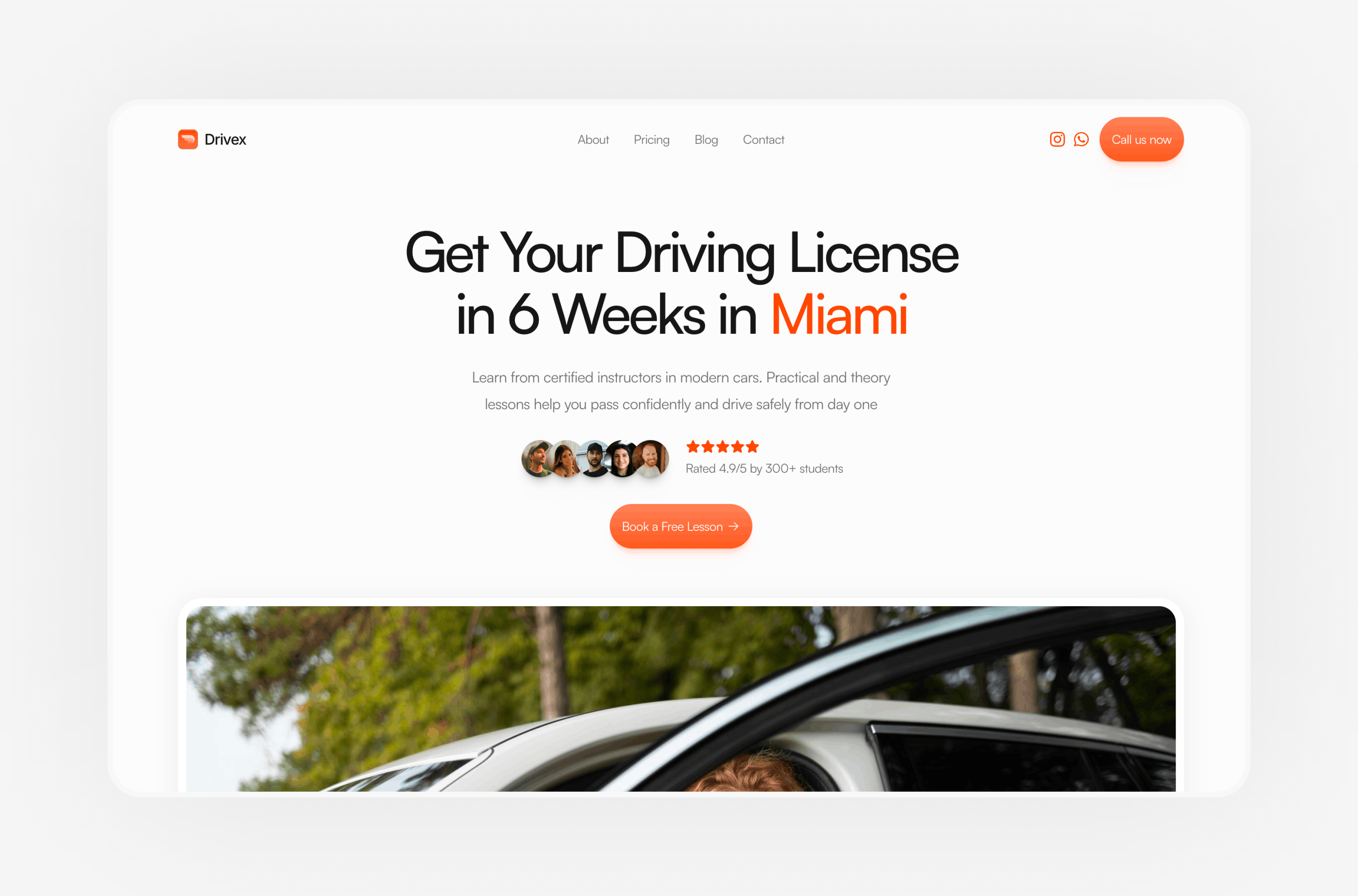
Example of a driving school website template: https://drivex.framer.website
ROI comparison
Return on investment depends on how efficiently a website converts visitors into students and how quickly it can be improved. Custom websites require a longer runway before ROI becomes measurable, and errors are more expensive to correct due to higher costs.
Template-based websites reach breakeven faster because costs are controlled and feedback arrives sooner. Even small conversion gains have a greater relative impact when the initial investment is lower. Over time, the ability to iterate based on performance data often outweighs the perceived flexibility of a fully custom build.
ROI favors solutions that minimize delay and maximize learning.
Conclusion
Choosing between a custom and template driving school website is a decision between uncertainty and efficiency. Custom builds carry higher upfront costs, longer timelines, and greater structural risk before results appear. Template-based websites offer faster launch, lower financial exposure, and a clearer path to return on investment.
For driving schools focused on enrollments, visibility, and sustainable growth, structure and speed matter more than bespoke design. Websites generate value not by being unique, but by working reliably and improving continuously.
The decision behind the website
When a driving school owner plans a new website, the real decision is not about design preference or visual style. It is a business decision that affects cost structure, speed to market, risk exposure, and how quickly the website starts generating student inquiries. Choosing between a custom-built website and a template-based solution defines how much uncertainty the business accepts before seeing any return.
Most driving school websites underperform not because they look outdated, but because the initial website choice delayed learning and locked resources into assumptions. To evaluate this decision correctly, it must be analyzed through cost, risk, and return on investment rather than creativity or uniqueness.
Cost structure
A custom driving school website usually involves layered costs that extend beyond the visible price tag. Design discovery, revisions, development iterations, and post-launch adjustments increase both direct expenses and opportunity cost. These investments are made before the site attracts traffic, ranks in search, or produces enrollments, which places immediate financial pressure on the business.
Template-based websites operate on a fixed and predictable cost model. The core structure, layout, and user flow already exist, allowing the driving school to focus spending on content, local SEO, and promotion instead of prolonged development. The financial difference is not marginal. Lower upfront cost reduces breakeven time and allows faster reinvestment into growth channels.
From a cost perspective, templates reduce downside without limiting the ability to scale.
Time to launch
Time is one of the most overlooked variables in website ROI. Custom websites often take weeks or months to launch due to planning cycles, feedback loops, and design changes. During this period, the website generates no SEO signals, no behavioral data, and no validation of assumptions. Every delay postpones learning and revenue.
A template-based driving school website can be launched quickly because the structure is already resolved. Pages, enrollment paths, and content hierarchy are in place, which allows the owner to move directly into refinement and optimization. Faster launch means earlier indexing in search engines, earlier trust signals, and earlier performance insights.
Speed compounds over time. A website that launches sooner has more opportunities to improve consistently and measurably.
Risk exposure
Custom websites introduce structural risk that is often invisible at the start. Information may be presented in an order that does not match how prospective students evaluate driving schools. Pricing may be hidden too late. Calls to action may be diluted by visual priorities. Fixing these issues after launch usually requires additional investment.
Template-based websites reduce this risk because they rely on established patterns. The structure reflects common decision-making behavior, which lowers friction and uncertainty for visitors. Many of the problems outlined in Common Driving School Website Mistakes Explained Clearly stem from structural decisions made too early without validation. Templates limit these mistakes by starting from proven layouts.
Risk in this context is not only financial. It is the risk of slow feedback and delayed correction.
SEO readiness
Search visibility depends on clarity and consistency more than originality. Custom websites frequently prioritize visual differentiation over crawlable structure, which delays SEO alignment until after launch. As a result, content hierarchy, internal linking, and page intent often need revision once traffic data becomes available.
Template-based driving school websites usually embed SEO fundamentals from the beginning. Logical page order, clean navigation, and content-first layouts help search engines understand the site quickly. When paired with a structure similar to what is explained in Driving School Website Structure That Converts Visitors, templates allow SEO efforts to compound earlier and more predictably.
SEO is not instant, but earlier alignment improves long-term ROI.
Practical example
A well-structured driving school template demonstrates how templates reduce risk without sacrificing professionalism. For example, a template like Drivex is built around clear program presentation, visible pricing logic, and direct enrollment paths. The layout prioritizes information flow rather than decoration, allowing the school to focus on content quality and local relevance instead of reinventing structure.

Example of a driving school website template: https://drivex.framer.website
ROI comparison
Return on investment depends on how efficiently a website converts visitors into students and how quickly it can be improved. Custom websites require a longer runway before ROI becomes measurable, and errors are more expensive to correct due to higher costs.
Template-based websites reach breakeven faster because costs are controlled and feedback arrives sooner. Even small conversion gains have a greater relative impact when the initial investment is lower. Over time, the ability to iterate based on performance data often outweighs the perceived flexibility of a fully custom build.
ROI favors solutions that minimize delay and maximize learning.
Conclusion
Choosing between a custom and template driving school website is a decision between uncertainty and efficiency. Custom builds carry higher upfront costs, longer timelines, and greater structural risk before results appear. Template-based websites offer faster launch, lower financial exposure, and a clearer path to return on investment.
For driving schools focused on enrollments, visibility, and sustainable growth, structure and speed matter more than bespoke design. Websites generate value not by being unique, but by working reliably and improving continuously.
The decision behind the website
When a driving school owner plans a new website, the real decision is not about design preference or visual style. It is a business decision that affects cost structure, speed to market, risk exposure, and how quickly the website starts generating student inquiries. Choosing between a custom-built website and a template-based solution defines how much uncertainty the business accepts before seeing any return.
Most driving school websites underperform not because they look outdated, but because the initial website choice delayed learning and locked resources into assumptions. To evaluate this decision correctly, it must be analyzed through cost, risk, and return on investment rather than creativity or uniqueness.
Cost structure
A custom driving school website usually involves layered costs that extend beyond the visible price tag. Design discovery, revisions, development iterations, and post-launch adjustments increase both direct expenses and opportunity cost. These investments are made before the site attracts traffic, ranks in search, or produces enrollments, which places immediate financial pressure on the business.
Template-based websites operate on a fixed and predictable cost model. The core structure, layout, and user flow already exist, allowing the driving school to focus spending on content, local SEO, and promotion instead of prolonged development. The financial difference is not marginal. Lower upfront cost reduces breakeven time and allows faster reinvestment into growth channels.
From a cost perspective, templates reduce downside without limiting the ability to scale.
Time to launch
Time is one of the most overlooked variables in website ROI. Custom websites often take weeks or months to launch due to planning cycles, feedback loops, and design changes. During this period, the website generates no SEO signals, no behavioral data, and no validation of assumptions. Every delay postpones learning and revenue.
A template-based driving school website can be launched quickly because the structure is already resolved. Pages, enrollment paths, and content hierarchy are in place, which allows the owner to move directly into refinement and optimization. Faster launch means earlier indexing in search engines, earlier trust signals, and earlier performance insights.
Speed compounds over time. A website that launches sooner has more opportunities to improve consistently and measurably.
Risk exposure
Custom websites introduce structural risk that is often invisible at the start. Information may be presented in an order that does not match how prospective students evaluate driving schools. Pricing may be hidden too late. Calls to action may be diluted by visual priorities. Fixing these issues after launch usually requires additional investment.
Template-based websites reduce this risk because they rely on established patterns. The structure reflects common decision-making behavior, which lowers friction and uncertainty for visitors. Many of the problems outlined in Common Driving School Website Mistakes Explained Clearly stem from structural decisions made too early without validation. Templates limit these mistakes by starting from proven layouts.
Risk in this context is not only financial. It is the risk of slow feedback and delayed correction.
SEO readiness
Search visibility depends on clarity and consistency more than originality. Custom websites frequently prioritize visual differentiation over crawlable structure, which delays SEO alignment until after launch. As a result, content hierarchy, internal linking, and page intent often need revision once traffic data becomes available.
Template-based driving school websites usually embed SEO fundamentals from the beginning. Logical page order, clean navigation, and content-first layouts help search engines understand the site quickly. When paired with a structure similar to what is explained in Driving School Website Structure That Converts Visitors, templates allow SEO efforts to compound earlier and more predictably.
SEO is not instant, but earlier alignment improves long-term ROI.
Practical example
A well-structured driving school template demonstrates how templates reduce risk without sacrificing professionalism. For example, a template like Drivex is built around clear program presentation, visible pricing logic, and direct enrollment paths. The layout prioritizes information flow rather than decoration, allowing the school to focus on content quality and local relevance instead of reinventing structure.

Example of a driving school website template: https://drivex.framer.website
ROI comparison
Return on investment depends on how efficiently a website converts visitors into students and how quickly it can be improved. Custom websites require a longer runway before ROI becomes measurable, and errors are more expensive to correct due to higher costs.
Template-based websites reach breakeven faster because costs are controlled and feedback arrives sooner. Even small conversion gains have a greater relative impact when the initial investment is lower. Over time, the ability to iterate based on performance data often outweighs the perceived flexibility of a fully custom build.
ROI favors solutions that minimize delay and maximize learning.
Conclusion
Choosing between a custom and template driving school website is a decision between uncertainty and efficiency. Custom builds carry higher upfront costs, longer timelines, and greater structural risk before results appear. Template-based websites offer faster launch, lower financial exposure, and a clearer path to return on investment.
For driving schools focused on enrollments, visibility, and sustainable growth, structure and speed matter more than bespoke design. Websites generate value not by being unique, but by working reliably and improving continuously.
Frequently Asked Questions
Is a custom driving school website better than a template?
A custom website is not inherently better than a template. In many cases, templates provide a clearer structure, faster launch, and lower financial risk, while custom websites mainly offer visual flexibility at a higher cost and longer timeline.
How much does a driving school website usually cost?
The cost of a driving school website varies widely. Custom websites often cost several thousand dollars before launch, while template-based websites have a fixed, predictable cost and can be launched with significantly lower upfront investment.
Can a template driving school website rank well in Google?
Yes, a template-based driving school website can rank well if it is built with a clear structure, proper content hierarchy, and SEO fundamentals. Search engines prioritize clarity, relevance, and usability over custom visual design.
Which option delivers a better return on investment for driving schools?
For most driving schools, template-based websites deliver a better return on investment due to lower initial costs, faster launch, and earlier access to performance data that allows ongoing optimization.
Is a custom driving school website better than a template?
A custom website is not inherently better than a template. In many cases, templates provide a clearer structure, faster launch, and lower financial risk, while custom websites mainly offer visual flexibility at a higher cost and longer timeline.
How much does a driving school website usually cost?
The cost of a driving school website varies widely. Custom websites often cost several thousand dollars before launch, while template-based websites have a fixed, predictable cost and can be launched with significantly lower upfront investment.
Can a template driving school website rank well in Google?
Yes, a template-based driving school website can rank well if it is built with a clear structure, proper content hierarchy, and SEO fundamentals. Search engines prioritize clarity, relevance, and usability over custom visual design.
Which option delivers a better return on investment for driving schools?
For most driving schools, template-based websites deliver a better return on investment due to lower initial costs, faster launch, and earlier access to performance data that allows ongoing optimization.
Is a custom driving school website better than a template?
A custom website is not inherently better than a template. In many cases, templates provide a clearer structure, faster launch, and lower financial risk, while custom websites mainly offer visual flexibility at a higher cost and longer timeline.
How much does a driving school website usually cost?
The cost of a driving school website varies widely. Custom websites often cost several thousand dollars before launch, while template-based websites have a fixed, predictable cost and can be launched with significantly lower upfront investment.
Can a template driving school website rank well in Google?
Yes, a template-based driving school website can rank well if it is built with a clear structure, proper content hierarchy, and SEO fundamentals. Search engines prioritize clarity, relevance, and usability over custom visual design.
Which option delivers a better return on investment for driving schools?
For most driving schools, template-based websites deliver a better return on investment due to lower initial costs, faster launch, and earlier access to performance data that allows ongoing optimization.